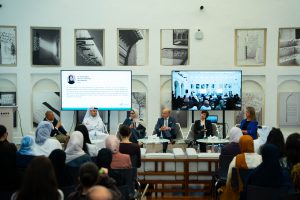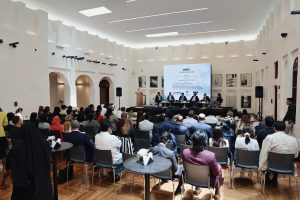



Msheireb Museums hosted the annual exhibition “Architectonics: From Education to Impact,” organized by the Department of Architecture and Urban Planning at the College of Engineering at Qatar University (QU). The exhibition highlighted graduation projects and academic coursework developed by more than 40 undergraduate students and alumni.
Held at Msheireb Downtown Doha, the exhibition traced the evolution of architectural concepts from foundational academic coursework to final thesis projects, reflecting how emerging architects in Qatar are responding to environmental, social, and urban challenges while preserving the country’s cultural identity.
On the sidelines of the exhibition, prominent Qatari architect Ibrahim Jaidah, CEO and Chief Architect of the Arab Engineering Bureau (AEB), honored a selection of promising projects, underscoring the importance of supporting the next generation of architects in Qatar.
The selection of Msheireb Downtown Doha as the exhibition venue carried particular significance. Following three years of intensive architectural research, the city adopted a distinctive Qatari design vision embodied in the “Seven Architectural Concepts,” a framework that integrates the spirit and aesthetics of traditional Qatari architecture with modern technology and sustainable design principles. Through this approach, documented in publications such as Building on Tradition – The New Architectural Language of Qatar and Msheireb Museums: Transforming Doha’s Heritage Houses, and through collaboration with internationally renowned architects, academics, and urban planners, Msheireb Downtown Doha has become a global model for sustainable urban regeneration. For participating students, the city served as a living reference and a practical case study of what architecture rooted in scientific research and national heritage can achieve.
In this context, Mr. Abdulla Al Naama, Director General of Msheireb Museums, said, “Hosting this exhibition at Msheireb Museums is a natural extension of the identity of these heritage houses. Built within a city shaped by years of architectural research grounded in Qatari heritage, the museums provide spaces that enable young architects to engage with the concepts and ways of thinking that shaped Msheireb Downtown Doha. We are pleased to support QU in providing this platform and to witness a new generation of architects addressing issues of identity, sustainability, and community—the same principles that continue to guide our work.”
The projects featured in the exhibition were developed in collaboration with several national and international entities, including the Ministry of Municipality, Qatar Museums, Caravane Earth, and the Public Works Authority (Ashghal), in addition to leading international firms such as OMA / AMO and Herzog & de Meuron. These collaborations reflect a shared commitment to advancing architecture as a discipline rooted in science, interdisciplinary thinking, and design excellence.
Dr. Abdullah Al Nuaimi, Head of the Department of Architecture and Urban Planning at the College of Engineering at QU, said, “Architecture is an essential part of the broader engineering ecosystem, where creative ideas are transformed into engineering solutions through scientific thinking, technical precision, and a deep understanding of community needs. This exhibition demonstrates how students of the Department of Architecture and Urban Planning contribute to addressing important social, environmental, and urban issues through design ideas grounded in engineering knowledge, sustainability, technology, and practical, applicable solutions.”
He added, “The showcased projects reflect QU’s commitment to preparing graduates capable of developing thoughtful, responsible engineering solutions with tangible impact on Qatar’s urban environment. These projects also highlight the ability of architectural education to connect various disciplines within the college, including environmental performance, building systems, urban infrastructure, digital tools, and sustainable development.”
Dr. Al Nuaimi further emphasized the importance of architecture as a tool for advancing innovation, stating, “Through experiential learning, research-based design, and collaboration with national and international partners, the Department of Architecture and Urban Planning at the College of Engineering continues to support academic experiences that connect education with real-world impact. We are proud of our students, faculty members, and partners for what this exhibition reflects regarding the role of architecture in promoting innovation, preserving cultural identity, and delivering engineering solutions that respond to community needs and support Qatar’s future development journey.”
The exhibition “Architectonics: From Education to Impact” further reinforces Msheireb Downtown Doha’s position not only as a prominent urban destination but also as a catalyst for ongoing architectural dialogue that connects lessons from the past with the aspirations of future cities.